
Change Readiness Assessment
Change rarely fails because of bad strategy. It fails because the organisation wasn't ready.
A Change Readiness Assessment (CRA) is one of the most powerful - and most underused - tools in a change practitioner's kit.
This article walks you through what a CRA is, why it matters, and how to run one effectively. Whether you are preparing for a major transformation or a targeted process change, the principles are the same: know where your organisation stands before you ask it to move.
What is a Change Readiness Assessment?
A Change Readiness Assessment is a structured evaluation of how prepared an organisation, its leaders, managers, and frontline people, are to adopt and sustain a change initiative.
The key distinction: a CRA does not assess what is changing. That is the job of a Process or Complexity Change Impact Assessment.
A CRA assesses whether the organisation is ready to change right now; its awareness, receptivity, and capability.
Three Core Factors a CRA Examines
Awareness: Do people know what is coming, why it is happening, and what it means for them?
Receptivity: Are leaders and employees open and supportive, or is there resistance building below the surface?
Capability: Do people have the skills, tools, time, and resources to make the transition successfully?
A CRA may reveal that the organisation is not yet ready for change. That is not a failure, it is exactly the kind of intelligence that prevents costly, rushed implementations. It tells you what must be done before you proceed.
Beyond its diagnostic value, a well-run CRA is also a relationship-building exercise. It creates structured touchpoints with stakeholders across the organisation, builds trust with the change team, and signals that people's perspectives matter.
Why a CRA Matters
The larger and more impactful the change, the more thoroughly readiness must be assessed. But even for smaller initiatives, a focused CRA pays dividends. Surfacing risks early, informing communication and training strategies, and giving sponsors a realistic view of adoption challenges before they become adoption failures.
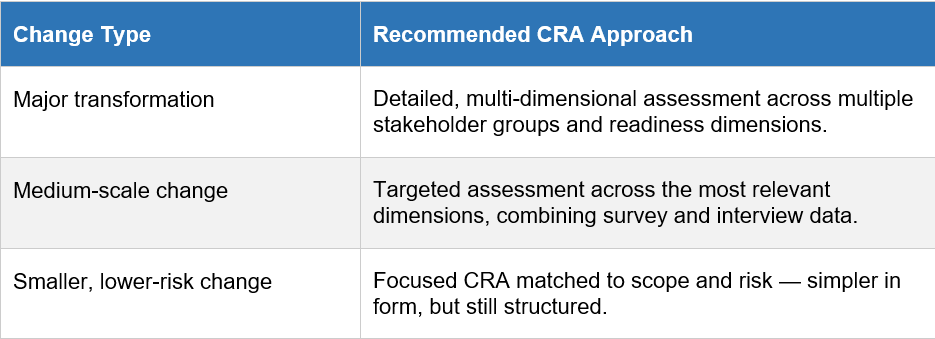
Critically, a CRA should not be a one-time event. Readiness is dynamic. It shifts as competing priorities emerge, leadership changes, or external conditions evolve. Best practice is to conduct at least two assessments: one at the start of the programme to establish a baseline, and one closer to implementation to measure how readiness has changed, and where gaps remain.
Before You Start: Prerequisites
A CRA does not happen in isolation. Before launching your assessment, ensure the following are in place:
- A Blast Radius or Change Impact Assessment has been completed. So you understand the scope and scale of the change before gauging readiness for it.
- A high-level Stakeholder Identification has been done. So you know whose readiness to assess and who the key influencers and potential resistors are.
- The transformation scope has been clearly defined and communicated. People cannot give meaningful readiness feedback about a change they do not yet understand.
This last point deserves emphasis. Before surveying your stakeholders, make sure they have had access to clear, honest communications about what is changing, why, and what it means for them. Asking people to rate their readiness for a change they have only heard rumours about produces noise, not signal, and risks generating anxiety you are not yet equipped to address.
The Five Steps of a Change Readiness Assessment
Running an effective CRA follows a clear process. Here is how each step works in practice.
Step 1: Create an Assessment Plan
Define the scope, objectives, timing, and participants of your assessment. Decide which readiness dimensions you will cover, leadership commitment, employee awareness, capability, communication effectiveness, implementation preparedness, and so on. And how you will weight them given the nature of the change.
Select your tools: X4MIS CRA template, public instruments, or a custom design. Document your planned approach, including your understanding of the organisation's current environment, stakeholder attitudes, and available resources.
At this stage, also plan your risk mitigation. Asking employees questions about an upcoming change can generate anxiety, particularly if leadership is not yet prepared to respond to concerns. Mitigate this by ensuring communications are well ahead of your assessment, that people know why they are being asked, and that there are clear channels for questions and concerns. Enable confidentiality wherever possible.
Step 2: Compile the Questions
The quality of a CRA is determined by the quality of its questions. Design questions that span all relevant readiness dimensions, are specific enough to prompt action, and open enough to surface unexpected risks or strengths.
For survey instruments, questions should be converted into statements that participants rate on an agree/disagree scale (1 = Strongly Disagree to 5 = Strongly Agree). This produces data that is comparable across groups and trackable over time.
Practitioner Tip: Write Statements, Not Questions
Abstract, organisation-level statements ('Roles and responsibilities are clearly defined') produce weaker data than first-person, practitioner-focused statements ('I know who is responsible for what during the implementation of this change.').
Practitioner-focused statements are more accessible to frontline employees, more honest in their responses, and more actionable for change teams. Always include a free-text field for comments and suggestions, this is often where the most valuable insight lives.
Step 3: Conduct Interviews and Gather Data
Engage a wide and representative range of stakeholders. For example, leaders, managers, team members, and where relevant, external parties such as customers, vendors, or suppliers. The broader your sample, the more accurate and defensible your findings.
You have several options for how to gather data:
- Surveys for broad, quantitative measurement across large groups.
- One-on-one interviews for in-depth exploration of perceptions and concerns.
- Focus groups to gather qualitative data from multiple people efficiently.
- Internal managers conducting structured conversations with their own teams, particularly effective where they already have strong relationships and contextual knowledge.
- External consultants where independence and neutrality are important to the quality of feedback.
Remember: the CRA is a planning tool, not the main event. Keep the process proportionate to the size of the change and the time available. A focused, well-executed assessment with a representative sample is far more valuable than an exhaustive process that delays everything else.
Step 4: Analyse the Findings
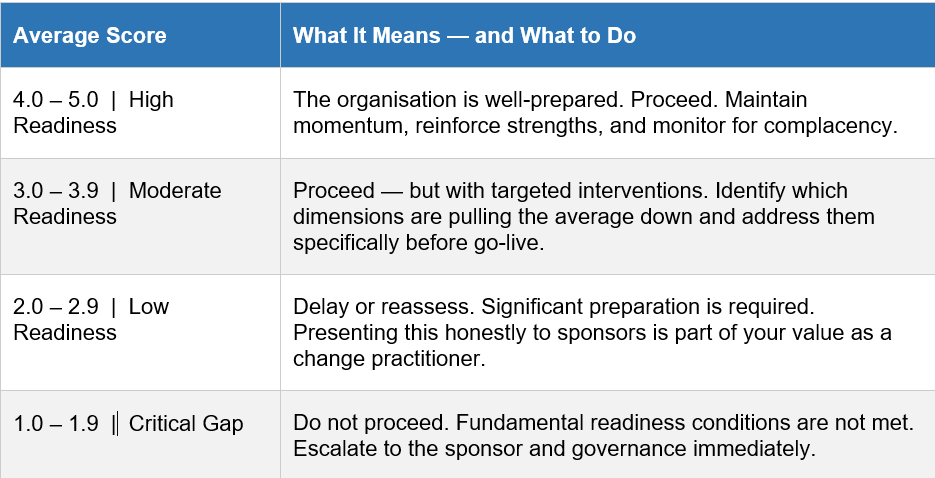
Once data is collected, consolidate it systematically. Look for patterns and themes, not just what people said, but what the distribution of responses reveals. A high average score that masks a cluster of low scores in a critical stakeholder group is a warning signal, not a green light.
Capture issues and opportunities identified by stakeholders. Use a Risk Register to document potential risks that emerge from the data. Cross-reference your findings with your Stakeholder Analysis and Impact Assessments. Readiness gaps often align closely with high-impact groups, and that correlation matters for prioritisation.
Pay particular attention to where scores differ significantly between stakeholder groups. A senior leadership cohort scoring 4.2 on 'I understand the purpose of this change' alongside a frontline cohort scoring 2.4 on the same statement is not a minor variance — it is a fundamental readiness problem.
Step 5: Produce the Report
The CRA Report is the synthesis of everything you have gathered. It should define the organisation's current readiness state, its strengths, its gaps, and what must happen before proceeding.
A well-structured CRA Report includes:
- An overall readiness score and readiness level by dimension.
- Key insights: where readiness is strong, where it is fragile, and where it is critical.
- A breakdown of readiness by stakeholder group, not just aggregate averages.
- Specific, prioritised recommended actions for the change team, sponsors, and project leadership.
- A Go / Proceed with Caution / Do Not Proceed recommendation for the sponsor and governance group.
Share the report with the sponsor, senior stakeholders, and the change management team for validation. The sponsor's role is to confirm whether the CRA provides sufficient clarity, and to make the call on whether to proceed, refocus, or pause the initiative.
Interpreting Readiness Scores
CRA statements are rated on a 1–5 scale. Scores are averaged by dimension and overall to build a readiness profile. Here is how to interpret what you see:
A CRA is a powerful planning tool, but it has limits that every practitioner should understand and communicate:
- It is a snapshot, not a permanent state. Readiness shifts. Reassess at regular intervals throughout the programme, particularly before major milestones.
- It depends on honest responses. Hierarchy effects and fear of consequences can suppress candid feedback. Design for psychological safety, anonymity, clear communication about how data will be used, and visible leadership support for the process.
- Scores alone don't tell the full story. Free-text comments and qualitative interviews often reveal the why behind a low score, which is what you actually need to design an effective response.
- High averages can mask critical pockets of resistance. Always examine results by stakeholder group, not just overall. Where frontline scores diverge sharply from leadership scores, that divergence is the finding.
A well-executed Change Readiness Assessment does not just measure where an organisation is. It becomes a catalyst building relationships, surfacing risks before they become crises, and giving sponsors and change teams the intelligence they need to intervene early and effectively.
Readiness is not a binary, ready or not. It is a spectrum, and the CRA is your map of where every group sits on that spectrum, what is holding them back, and what needs to happen next.
Download the Change Readiness Assessment Template

